Engagement is no longer the scoreboard — the real issue is creative misdiagnosis
New research reveals why engagement can misdiagnose creator campaign success and how brands can use attention, brand memory and fit to optimise.
Creator marketing has spent years reporting the numbers that are easiest to see: views, Likes, Comments, Shares, watch time, and engagement rate.
They are simple to collect, easy to compare and convenient to place in a post-campaign report.
When the numbers rise, the content is declared a success. The creator may be rehired, the format repeated, and the best-performing post given more paid support.
But new research suggests this process may be doing more than giving brands an incomplete picture. It could be leading them to make the wrong creative decisions.
It measured creative responses from 182,550 TikTok users and linked them to in-market brand lift data. In total, the dataset represents an estimated $70.5 million in media spend and 23.6 billion impressions.
Its central finding is increasingly familiar: Engagement Rate is not a reliable indicator of whether people remembered the advertiser.
The more important implication, however, is what happens next.
When brands use engagement to determine which creator content deserves more budget, they risk scaling the content that generated the loudest reaction rather than the strongest branded memory.
That is not simply a measurement gap. It is creative misdiagnosis.
Engagement creates creative false positives
A creator post can succeed as content and fail as advertising.
People may enjoy the joke, recognise the trend or feel strongly enough to leave a comment. They may remember the creator’s delivery and send the video to a friend.
But none of that guarantees they will remember the brand.
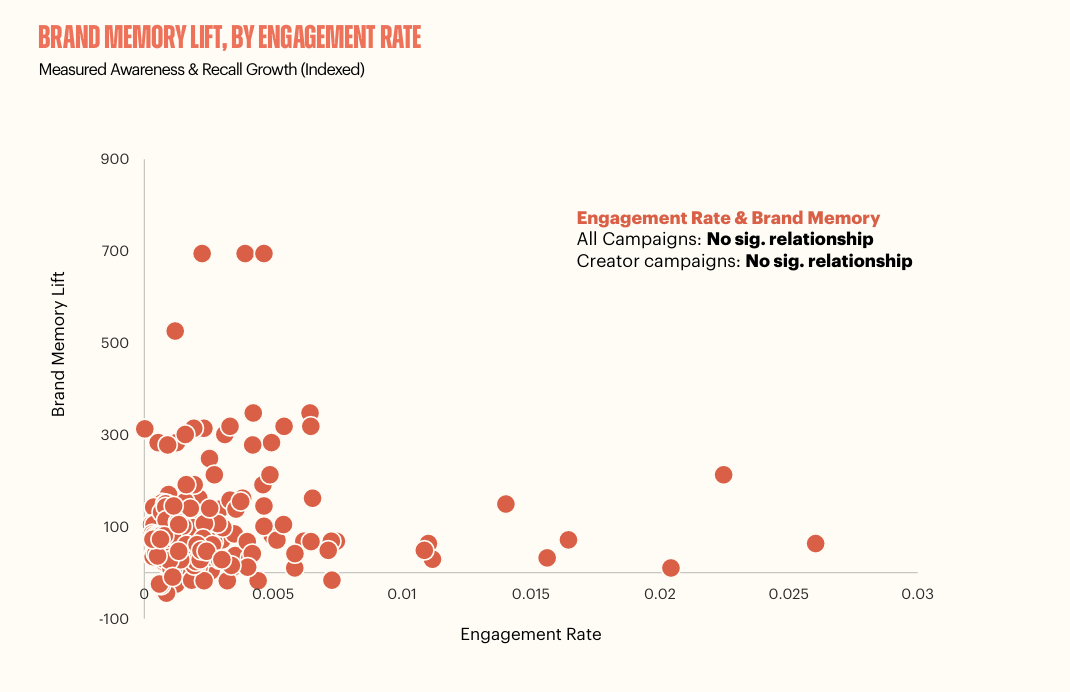
Across 129.6 million engagements examined in the study, Engagement Rate showed no significant relationship with Brand Memory Lift. Even comments-to-likes — a more active signal than tapping a heart — explained only 11.3% of the variation for creator campaigns.
Creative Quality, defined as positive emotion combined with brand recognition within the first two seconds, explained 54.6% of the variance.
That gap exposes a dangerous false positive: content that looks successful through the most visible metrics but fails the brand-building job it was commissioned to perform.
Fabulate’s Nathan Powell (co-founder and chief product and strategy officer) said one of the biggest mistakes marketers continue to make is treating engagement as the primary measure of creative effectiveness.
“Engagement remains an important metric for platform algorithms, but this study shows advertisers should place far less weight on it when judging creative effectiveness,” he said.
“Likes, comments and shares tell platforms whether content deserves wider distribution. They don’t necessarily tell you whether someone actually remembered your brand.”
The risk begins when reporting becomes optimisation.
A high-engagement post may receive more paid support. Other creators may be asked to reproduce its hook. The brand may decide the creator is an especially strong partner.
But engagement alone cannot explain what drove the reaction.
Was it the brand, or would the joke have worked just as well without it?
Was the audience responding to the product, the creator, the controversy or the comment section?
When brands cannot answer those questions, they risk amplifying the content that generated the loudest response instead of the strongest branded memory.
The metric does not just evaluate the work. It shapes what gets made next.
Attention is a better live signal, but not the final score
Brand Lift data will not always be available while a campaign is live. That leaves marketers with a practical question: what should replace engagement when deciding which assets deserve more budget?
Powell believes attention metrics provide a better starting point than others.
“If you’re trying to build brands, attention matters far more than interaction,” he said.
“The longer somebody voluntarily spends with a piece of content, the greater the opportunity for the brand message to be encoded into memory.”
A creator video that holds someone for 20 or 30 seconds may therefore create more advertising opportunities than one that attracts thousands of quick reactions before viewers move on.
But attention should not simply become the next “catch-all metric.”
The report itself moves the journey from “conversation to engagement”, through attention, towards Brand Memory. Creators may command attention, but the brand still needs to own the feeling that attention creates.
Early branding and emotional response must work together; otherwise, the memory may remain with the creator or the entertainment rather than the advertiser.
Attention is best treated as a useful live diagnostic — not proof of the final outcome.
Powell said brands should combine “watch time” and “view duration” with signals indicating deeper intent, including search lift, profile visits, website sessions, product-page traffic, and downstream conversions.
“Amplification decisions should be based on signals that demonstrate genuine consumer attention and business impact, not simply the metrics that happen to be easiest to measure,” he said.
That also means accounting for the delayed nature of advertising.
A person may watch creator content today, remember it next week and purchase a month later when they enter the category. Measuring only the first few hours after exposure risks missing much of the effect.
Powell said Fabulate’s closed-loop reporting is designed to connect outcomes such as purchases, app installs and website activity back to individual creators across platforms, including actions that occur after the immediate campaign window.
The goal is not to replace one simplistic scoreboard with another. It is to connect exposure, attention, memory and commercial behaviour more intelligently.
The ‘brilliant minority’ is operating a better system
The playbook revealed that creator ads build more Brand Memory overall than brand-made ads, but the advantage is highly concentrated.
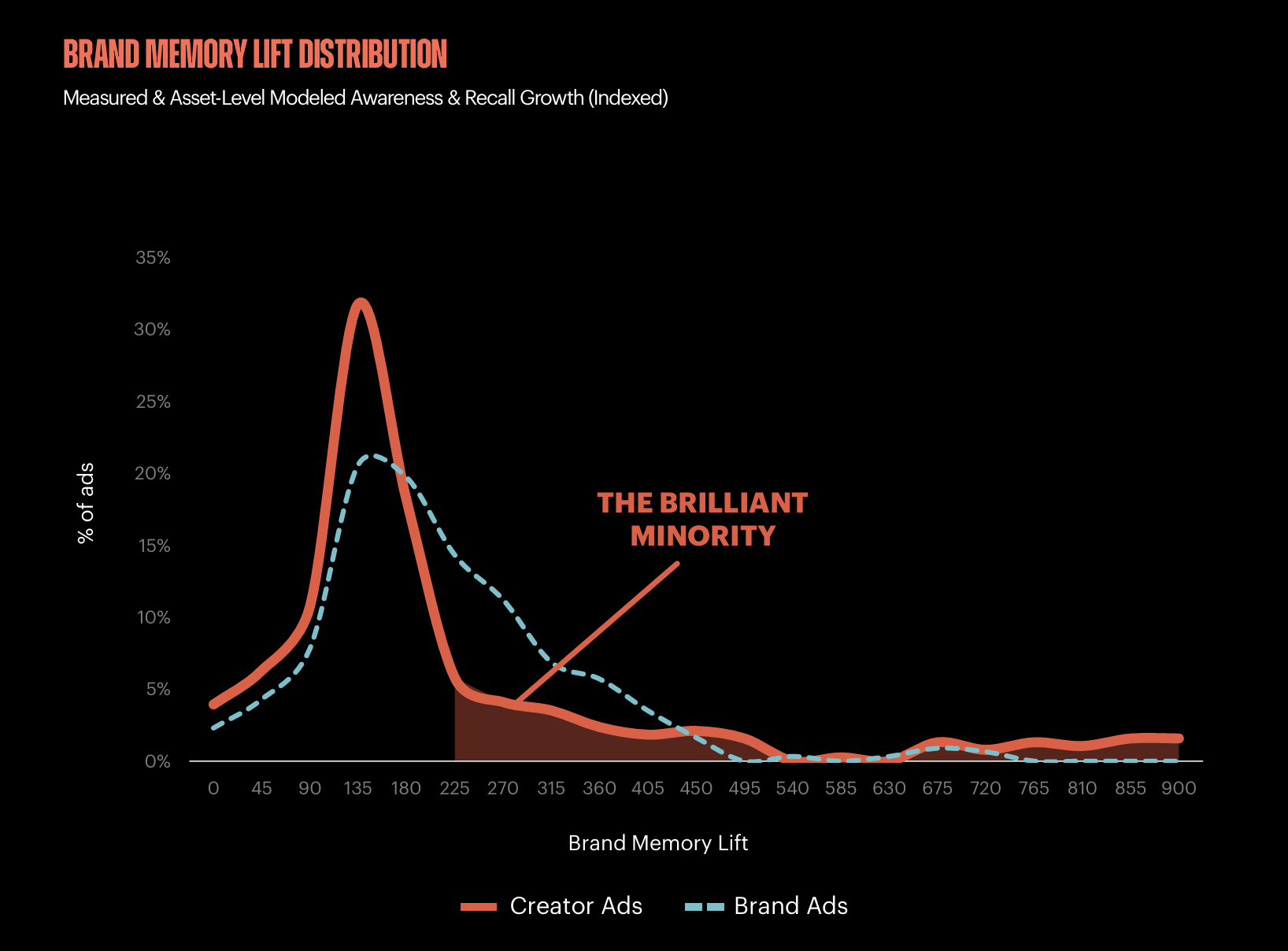
Only 29% of creator ads beat the average brand ad. The top 20% generated 45% of all creator Brand Memory Lift, while the top 10% delivered around four times more lift per asset than the rest.
The channel’s effectiveness is being carried by what the researchers call a “brilliant minority”. The easy conclusion would be that this minority simply produces better ideas.
Powell argues the real difference sits behind the creative.
“The brilliant minority aren’t simply producing better creative,” he said. “They’re operating better systems.”
According to Powell, four factors separate the brands producing consistently effective creator work from those relying on occasional creative hits:
- Choose the right partner: Creator marketing changes quickly. Platform algorithms evolve, creative trends disappear almost overnight, and audience behaviour continues to shift. Specialist partners have visibility across thousands of campaigns, relationships with the platforms and performance data at a scale most individual brands cannot access alone. That perspective allows them to spot changes before they become obvious to the wider market.
- Use meaningful data, not instinct: Every creator campaign produces signals about what works. Which hooks retained attention? Which creator styles drove stronger watch time? Which storytelling formats generated the highest conversion rates? Which creators consistently outperformed their category? Technology allows brands to aggregate those lessons across hundreds or thousands of assets rather than treating every campaign as a fresh experiment.
- Apply AI to previous learnings: At Fabulate, AI is used to analyse creative patterns, creator performance, audience behaviour and historical campaign results. This means every new campaign can benefit from what the brand has already learned, rather than depending on subjective opinions in a creative review meeting.
- Build for operational agility: Social moves faster than most advertising channels. What performed six weeks ago may already feel dated. The brands that succeed have workflows that allow them to test, learn, optimise and reallocate budget while campaigns are still live, rather than waiting until the end-of-campaign report arrives.
Social behaviours and platform conventions change quickly. Brands that wait until the post-campaign report to determine what worked have already lost the opportunity to improve the live campaign.
The highest-performing programmes are set up to test, learn and reallocate budget while the work is still in the market.
That requires another operational change: creative and media can no longer work in sequence.
Too often, one team commissions the creator content while another later decides what to amplify, using a separate set of objectives. By the time the media team becomes involved, creative decisions that determine memory, attention, and conversion have already been locked in.
Powell said the strongest brands plan creator strategy, production, measurement, and paid amplification together from day one, not one day.
They are not only making better content. They are creating the conditions that make better content more likely.
Fame is not fit

The report’s other major warning is against confusing a creator’s fame with their value to the advertiser.
Creator Fame gives an ad a head start because the audience recognises the creator or immediately understands their world.
Brand Fit works harder.
The research found that a recognisable creator perceived as a strong match for the advertiser nearly doubled Brand Memory Lift compared with work in which both Fame and Fit were low. When brands need to prioritise one, the report recommends protecting Brand Fit.
A smaller creator in the right context can be a stronger choice than a major name where the product feels bolted on.
At Fabulate, we've said this for a while: “Follower count has become one of the least useful ways to evaluate a creator.”
“Creator fame tells you they’ve been successful at building their own brand. It doesn’t necessarily tell you they’ll be effective at building yours.”
That distinction is becoming more important as content discovery shifts from follower-led feeds towards algorithmic recommendations.
Brands should look beyond the size of an existing audience and assess how consistently a creator’s content earns attention. Average views, watch time, completion rates and retention can provide a clearer picture than follower totals alone.
Brand Fit also extends beyond demographic overlap.
Reaching women aged 25 to 34 does not automatically make someone the right creator for every brand targeting that group.
Marketers need to consider the creator’s storytelling style, production approach, values, category relevance, previous partnerships, competitor activity and whether their audience has demonstrated genuine interest in the product area.
Powell said AI can help brands examine entire content libraries for recurring themes, language, sentiment, objects and historical performance, moving selection beyond manual review and surface-level statistics.
The strongest programmes also spread risk.
Rather than building a campaign around one superstar, brands can combine larger creators for reach with micro and nano creators who can deliver greater trust, category relevance, or conversion.
The point is not that smaller is automatically better. It is that fame should never be mistaken for fitness.
From reporting to diagnosis
Engagement still has a role.
It can show whether people reacted to a post and whether the platform is likely to distribute it further. Views and reach reveal delivery. Watch time helps indicate attention.
Brand Lift measures changes in awareness and recall. Search and conversion data provide signals of intent and commercial impact.
Each metric answers a different question.
Creative misdiagnosis starts when a single convenient number is asked to answer them all.
A more useful creator scorecard should distinguish between four things:
- Did people see the content?
- Did it hold their attention?
- Did they remember the brand?
- Did that memory contribute to meaningful behaviour?
The first two may help marketers optimise while a campaign is running. The latter two reveal whether that optimisation created advertising value.
The wider implication of the research is therefore not simply that engagement is an imperfect metric.
It is that bad measurement compounds.
It rewards the wrong assets, informs the wrong briefs, pushes budget towards the wrong creators and teaches the organisation the wrong lessons.
When the scoreboard identifies the wrong winner, brands do not just misunderstand the outcome of the campaign.
They make the next one worse.
.jpg)










.png)

.png)
.png)
.png)
.png)
.png)
.png)
.png)
.png)
.png)
.png)
.png)
.png)
.png)
.png)
.png)
.png)
.png)
.png)
.png)
.png)
.png)
.png)
.png)
.png)
.png)
.png)
.png)
.png)



.png)