.png)
Creator Economy 2025: What the IAB’s Latest Report Really Means for Brands
Creator marketing has moved from experiment to expectation. Using insights from the IAB’s 2025 Creator Economy report, this piece explores how creators are now planned and funded like a core media channel, alongside the challenges brands still face around discovery, measurement, and AI. The focus has shifted from proving whether creator marketing works to proving how well it performs at scale.
Creator marketing is no longer an add-on. It now sits at the centre of modern media planning.
The IAB’s 2025 Creator Economy Ad Spend & Strategy Report confirms what many brands are already experiencing in practice. Creator-led content is no longer experimental, discretionary, or confined to social teams. It is being planned, funded, and expected to perform like a core media channel.
What matters most in this report is not just the scale of growth, but what that growth reveals about how creator marketing is evolving, and where brands are still being held back.
Creator ad spend is accelerating, not plateauing
U.S. creator ad spend is projected to reach $37 billion in 2025, representing 26 percent year-on-year growth. That makes creator marketing one of the fastest-growing areas in media, expanding at roughly four times the rate of the overall media market.
This growth is not coming off a small base. Creator ad spend has more than doubled since 2021, increasing from $13.9 billion to $29.5 billion in 2024, with forecasts suggesting it could reach $43.9 billion by 2026.
This is a clear signal that creator marketing is no longer being treated as a short-term tactic. It is becoming a permanent part of how brands allocate budget.
Creators are now planned like a channel, not a tactic
Nearly half of brands (48 percent) now describe creator marketing as a must-buy within their media plans. Only social media and paid search rank higher.
This places creator marketing ahead of channels such as linear TV, online video, and digital audio. It shows creators are increasingly being planned alongside paid media channels, not bolted on after the fact.
“What we are seeing with clients mirrors this shift,” says Ben Gunn, Chief Revenue Officer at Fabulate. “Creator marketing is no longer being justified as a test. It is being planned alongside paid media, which means expectations around performance, governance, and measurement are rising fast.”
For brands, this raises an important implication. If creators are a must-buy, they need to be planned, measured, and optimised with the same discipline applied to other core channels.

Retail may lead, but creator marketing is now mainstream
Retail remains the largest category investing in creator marketing, with $12.3 billion forecast in 2025. CPG follows at $5.5 billion.
However, the more telling insight is that every major category is now investing meaningfully, with double-digit growth expected across finance, auto, telecoms, travel, tech, and health.
Creator marketing is no longer limited to categories traditionally associated with influencers. It is being applied to a wide range of commercial challenges, from demand generation to brand trust.
Creator investment goes far beyond influencer fees
One of the most persistent misconceptions about creator marketing is that it is simply about paying creators to post.
In reality, brands are investing across four distinct areas:
- Direct creator partnerships
- Paid amplification of creator content on social
- Paid amplification beyond social platforms
- Intentional ad adjacencies alongside creator content
More than 90 percent of brands invest across all four models, highlighting how creators are increasingly treated as scalable media assets as well as content partners.
This shift places greater importance on distribution, optimisation, and reuse of creator content, not just the creator themselves.
Mid-tier creators deliver the most consistent value
Despite the attention often given to celebrity creators, the report shows that brands most commonly work with creators in the middle.
61 percent of brands partner with mid-tier creators, defined as those with between 50,000 and 500,000 followers. Macro and micro creators follow closely behind.
This reflects a practical balance. Mid-tier creators often combine credible reach, consistent content quality, and manageable cost, making them easier to deploy at scale.
.png)
Discovery remains the biggest operational challenge
Despite growing budgets and experience, the most common challenge has not changed.
Finding the right creators remains the number one issue for brands, ranking ahead of measurement, scaling, and relationship management.
The underlying problem is fragmentation. Data, benchmarks, and performance signals vary widely by platform, making it difficult for brands to consistently assess creator quality and audience fit.
As investment grows, this lack of standardisation becomes a material risk rather than an inconvenience.
“As creator marketing scales, brands are leaning far more heavily on technology to support discovery and screening,” says Ben Gunn, Chief Revenue Officer at Fabulate. “When you are assessing hundreds or thousands of potential creators, relying on instinct or familiarity alone introduces risk and confirmation bias. Data-led tooling gives teams a way to challenge their own assumptions, pressure-test creator fit, and make more defensible decisions at scale.”
Brands want full-funnel impact, but measure narrow outcomes
The report shows brands are using creator marketing across the entire funnel.
Top objectives include building awareness, reaching new audiences, strengthening brand trust, and driving online sales.
However, when it comes to evaluation, ROI remains the most common KPI.
This ensures accountability, but it also exposes a disconnect. Many of the outcomes brands expect from creators are long-term and brand-led, yet they are often judged using short-term performance metrics.
Measurement remains the biggest barrier to confidence
Nearly 40 percent of brands cite proving ROI as their biggest challenge, followed closely by difficulties attributing sales and measuring long-term impact.
Most measurement still relies on platform-reported data, with limited use of independent verification, brand lift studies, or cross-channel attribution.
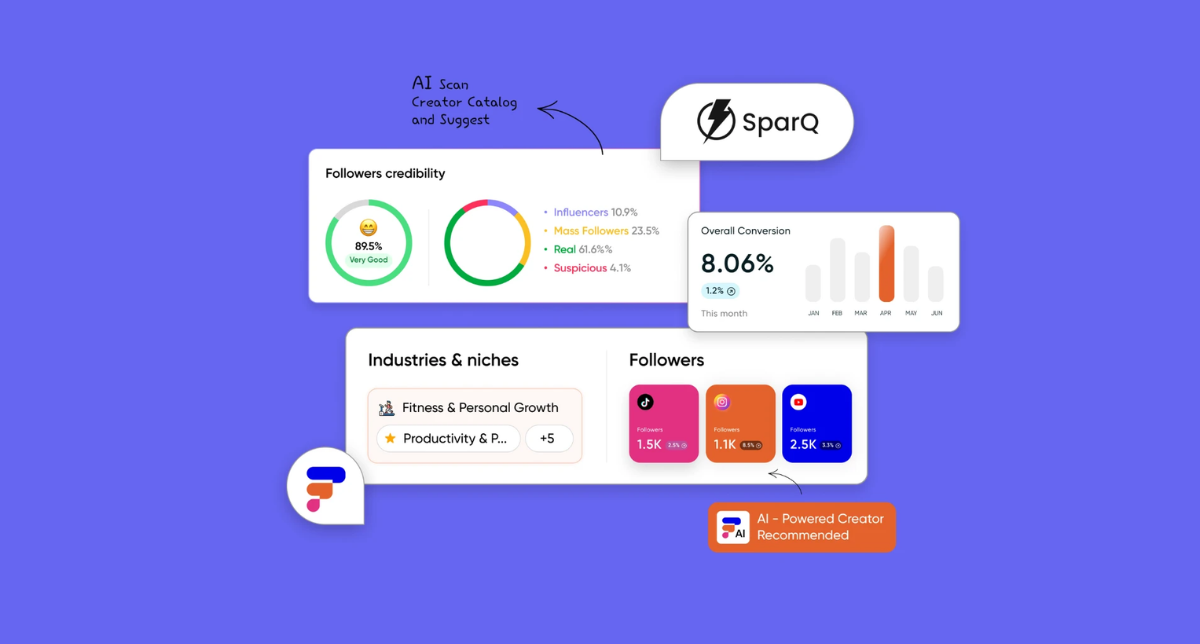
Ben Gunn puts it more bluntly when it comes to measurement. “As creator budgets scale, the conversation changes,” he says. “Brands stop asking if creators work and start asking how to deploy them with the same discipline as other media channels. That shift is exactly why Fabulate has invested heavily in SparQ, its AI-driven analytics and measurement tools, to give brands more credible, flexible options for understanding performance beyond surface-level metrics. Even so, many teams are still catching up.”
Until measurement standards mature, creator marketing risks being undervalued or misinterpreted, despite growing investment.
AI is accelerating creator marketing, but trust remains fragile
AI adoption is now widespread. Three in four brands are already using or planning to use AI for creator-related tasks, most commonly for content editing, briefing, personalisation, and reporting.
At the same time, 95 percent of brands express concerns, with loss of authenticity cited as the primary risk.
This tension will shape the next phase of creator marketing. AI is improving speed and efficiency, but brands are clearly cautious about eroding the human connection that makes creator content effective.
What this means for brands
The creator economy is no longer defined by experimentation. It is defined by expectation.
Budgets are larger, scrutiny is higher, and brands are under increasing pressure to demonstrate how creator marketing contributes to both brand and business outcomes.
The opportunity now lies in treating creator marketing with the same strategic discipline applied to other media channels. That means planning for scale, building for reuse, investing in better data, and measuring outcomes that reflect real brand impact.
Creator marketing is no longer about proving whether it works. It is about proving how well it works, and doing so consistently.
.jpg)











.png)

.png)
.png)
.png)
.png)
.png)
.png)
.png)
.png)
.png)
.png)
.png)
.png)
.png)
.png)
.png)
.png)
.png)
.png)
.png)
.png)
.png)
.png)
.png)
.png)
.png)
.png)
.png)



.png)