.png)
Creator Marketing Needs Measurement That Matches Its Influence
Creator marketing is delivering real commercial impact, but measurement has not evolved at the same speed. The next growth phase depends on integrating creators into formal media planning, forecasting and performance models rather than treating them as a standalone tactic.
Creator marketing is no longer experimental. It is embedded in brand strategy, central to cultural relevance and increasingly responsible for influencing purchase behaviour across the funnel. Brands do not turn to creators simply for engagement. They rely on them to shape perception, accelerate consideration and drive commercial outcomes in ways traditional advertising struggles to replicate.
The wider conversation around creator marketing has shifted and the question is no longer whether it works. The question is whether the systems used to measure it reflect its strategic importance.
In its January 2026 report examining the measurement landscape in the creator economy, the IAB highlights a structural inflection point. Creator investment has scaled rapidly, yet cross platform currency, forecasting discipline and independent verification have not evolved at the same pace. Influence has matured. Measurement infrastructure has not.
This does not indicate a weakness in the channel. Every major media category that has earned significant budget share has first had to evolve its measurement frameworks. Creator marketing has now reached that stage.
The Gap Is Not Performance. It Is Planning Integration.
The Real Constraint Is Planning Integration, Not Performance Itself
For most marketers, the strongest evidence of creator impact sits inside paid social results rather than organic dashboards. Creator-led creative often reduces cost per acquisition when blended with paid media. For example, during Black Friday, Fabulate partnered with TFE Hotels to run creator-driven partnership ads. These ads delivered a material reduction in CPA while supporting strong return on ad spend, reinforcing how creator content can directly improve paid media performance even under high audience saturation.
Case study: How creator partnership ads delivered a 5x ROAS for TFE Hotels during Black Friday
This is where creator marketing has already proven its commercial value. It is not simply driving engagement in isolation. It is enhancing the performance of paid media investment.
Yet when investment conversations move beyond the paid social team and into broader budget allocation discussions, the framing becomes more complex.
Questions become structural rather than tactical. How should creator content be modelled within paid media plans? Is it a creative input or a channel allocation? How does it influence blended cost efficiency across campaigns? What level of creator investment is required to sustain performance gains over time? How should uplift be forecasted rather than observed retrospectively?
These are not sceptical questions. They reflect the discipline applied to every other component of a performance ecosystem.
In many organisations, creator investment is still tracked separately from paid media modelling. Performance improvements are visible at campaign level, but they are not always attributed systematically within media planning frameworks. Uplift is reported after execution rather than forecasted during planning. As a result, creator content can materially improve paid efficiency while remaining underrepresented in strategic budget allocation.
The constraint is not proof of performance. It is the lack of models that allow creator impact to be forecasted, benchmarked and integrated into a single planning view alongside paid social, search and display.
Until creator investment is modelled as a core driver of paid social performance rather than an adjacent creative tactic, it will struggle to capture the level of allocation its impact justifies.
.png)
Engagement Was the Starting Point. It Cannot Be the Finish Line.
One of the most important shifts now underway is a move beyond flat engagement reporting.
Likes, comments and shares are valuable signals. They demonstrate interaction and community response. However, they do not function as a media currency. A passive like does not hold the same weight as a share. A view that lasts two seconds does not reflect the same value as one that carries through brand messaging.
The IAB report calls for greater standardisation and comparability across platforms. That is an important step. The deeper evolution lies in how effectiveness itself is defined.
For brands investing serious paid budgets, the question is no longer whether engagement exists. It is whether that engagement translates into measurable media contribution. Weighted effectiveness models that account for attention quality, retention and interaction depth provide a more accurate signal of commercial value than flat engagement totals. These models also allow creator content to be compared against other media channels in planning conversations.
Retention curves matter. Six second view through rates matter. Depth of engagement matters. When creators are integrated into paid media plans, understanding how content performs under amplification becomes even more critical.
This is not about replacing creativity with spreadsheets. It is about ensuring that creative investment is evaluated with nuance. When measurement frameworks reflect how audiences actually consume content, planning decisions become more informed and budget conversations become more confident.
Nathan Powell, Founder and Chief Product and Strategy Officer at Fabulate, summarises it clearly:
“Creator content is already outperforming brand creative in paid environments. The problem is not proof of performance. The problem is that most organisations are still measuring it as a campaign tactic rather than modelling it as media infrastructure. When you treat creator investment as a structural performance lever, the budget conversation changes.”
That distinction is important and this shifts the conversation from justification to optimisation.
Forecastability Drives Confidence
Every mature media channel offers some form of forecastability. Television provides reach modelling. Paid search offers predictable cost per acquisition ranges. Programmatic display can estimate impression delivery and frequency.
Creator marketing has historically been driven by cultural opportunity and creative alignment. That agility remains one of its strengths. At scale, however, senior marketers require the ability to model expected exposure and benchmark outcomes against previous activity.
Cross platform duplication remains difficult to quantify. Audience transparency varies. Independent verification standards are still developing. These factors introduce friction into planning processes, even when campaign performance is strong.
The January 2026 IAB report makes clear that the next wave of spend will be unlocked through greater standardisation, clearer supply paths and independent validation.
One of the most debated challenges in this space is deduplication. In walled garden environments, true cross platform person-level deduplication is not currently achievable. That is a structural constraint of the ecosystem.
Waiting for perfect visibility, however, is not a viable planning strategy. The more pragmatic approach is modelling intelligently within available parameters.
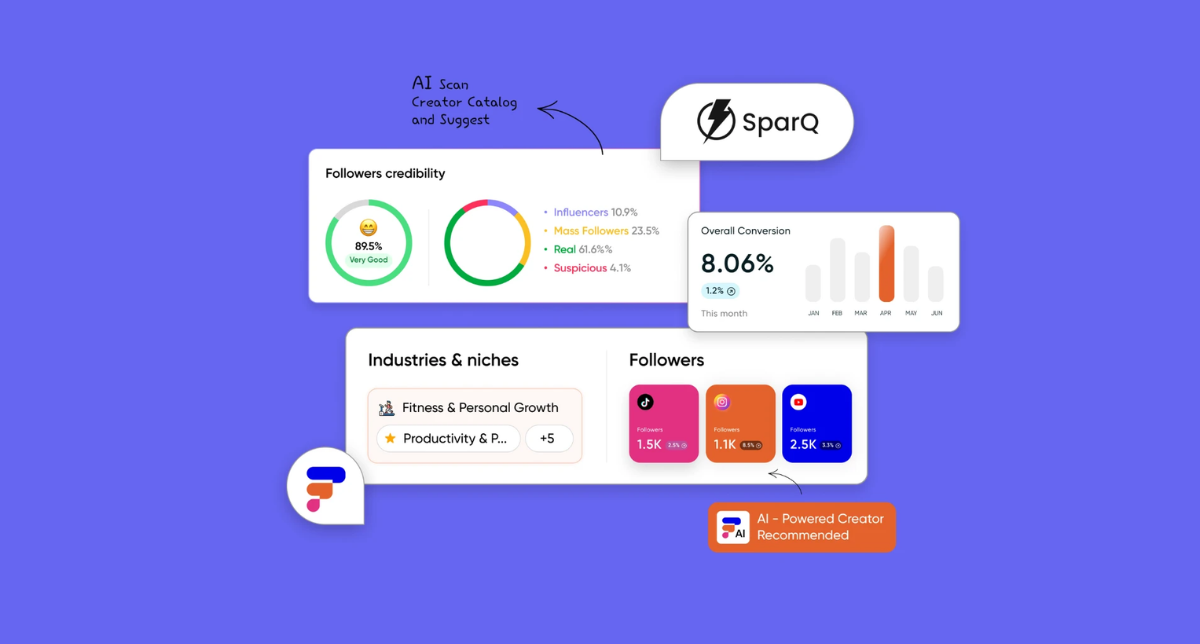
Audience overlap analysis is one such proxy. Within a single platform, analysing follower duplication across a proposed creator squad allows planners to design lineups that maximise unique reach rather than concentrating delivery within the same audience clusters. SparQ Audience Overlap, for example, enables marketers to model Instagram follower overlap before a campaign launches, creating a more structured approach to squad construction.
Once overlap is minimised, paid amplification becomes significantly more controllable. Boosting strategies can then be used deliberately to manage frequency and reach. This allows media teams to decide whether to increase exposure among high value segments to reinforce recall or expand distribution to maximise targeted reach. Creator content becomes a forecastable media input rather than a loosely measured creative asset.
When marketers can model creator reach alongside paid social and display, investment decisions become more strategic. When performance data feeds cleanly into broader reporting systems, finance teams gain clarity. When verification standards are consistent, procurement confidence increases.
.png)
Infrastructure Is the Quiet Growth Lever
Measurement architecture is not only about metrics. It is also about the systems that support governance, verification and operational clarity.
As creator programmes expand across markets and business units, operational complexity increases. Negotiations multiply, approvals require documentation and Brand safety checks demand consistency. Reporting must also reconcile inputs from multiple platforms.
Without structured systems, teams rely on manual processes and fragmented dashboards. That inefficiency does not immediately undermine performance, but it does slow scalability. It introduces friction at precisely the moment budgets are ready to grow.
Technology, when applied thoughtfully, reduces that friction. Centralised workflow platforms create audit trails. Unified reporting environments consolidate performance data.
API authenticated analytics remove reliance on screenshots or manual data pulls, ensuring that reporting is verified at source and capable of feeding directly into enterprise dashboards.
Fabulate’s strategy has been to invest in deep API integrations with major platforms to provide brands with the richest possible layer of authenticated insight. Recent integrations, including YouTube BrandConnect, ensure that campaign performance, audience signals and monetisation data are ingested directly from platform environments rather than inferred or manually reported.
This depth of integration strengthens transparency and reporting confidence, particularly when creator activity is integrated into broader paid media ecosystems. Data that can be authenticated at source feeds into enterprise models rather than being reconciled manually, allowing greater confidence in cross channel analysis.
AI can process large volumes of creator content to identify potential risks or audience misalignment, while human oversight ensures contextual judgement remains intact.
For creator marketing to secure long term budget growth, it must feel as governable and auditable as any other media investment.
When operational discipline aligns with sophisticated measurement, creator marketing becomes easier to defend, easier to scale and easier to integrate into long term planning cycles.
The Next Chapter Is Institutional
Creator marketing has already earned cultural legitimacy. Consumers trust creators. Brands rely on them. Performance results continue to demonstrate impact across industries.
The next chapter is institutional maturity.
That maturity will not dilute creativity. It will protect it. By embedding creator investment within formal media planning and reporting architecture, marketers can move beyond campaign by campaign justification and towards structured, scalable growth.
The January 2026 IAB report reinforces what many in the industry already recognise. The opportunity is not to prove that creators matter. It is to build the measurement frameworks that allow their influence to be modelled, benchmarked and forecasted with confidence.
As Nathan Powell puts it, “Creators are no longer an add on to paid media. They are improving its efficiency. The brands that win will be the ones that build measurement systems around that reality rather than treating it as a creative experiment.”
Creator marketing is ready for that evolution. The brands that invest in measurement sophistication now will be the ones that unlock its full commercial potential.
.jpg)












.png)

.png)
.png)
.png)
.png)
.png)
.png)
.png)
.png)
.png)
.png)
.png)

.png)
.png)
.png)
.png)
.png)
.png)
.png)
.png)
.png)
.png)
.png)
.png)
.png)
.png)
.png)
.png)



.png)